Open Access Articles
Linear Time-Series Models Match Deep Learning in Daily Solar Radiation Forecasting for Tropical Indonesia
Universitas Negeri Makassar, Indonesia
Universitas Negeri Makassar, Indonesia
* Author to whom correspondence should be addressed.
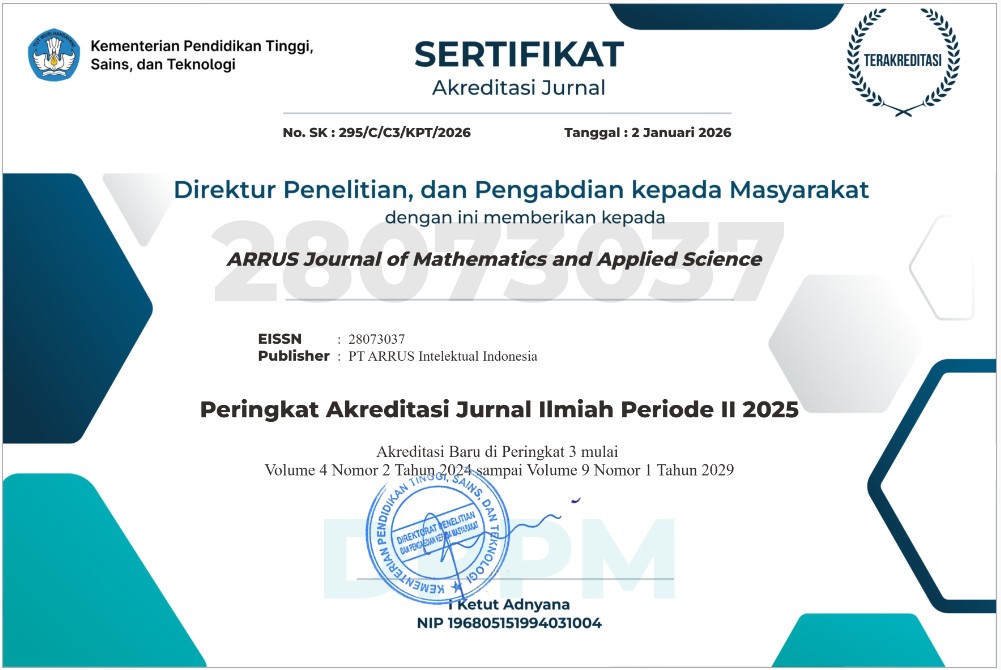
ARRUS Journal of Mathematics and Applied Science 2026, 6(3), 216-231; https://doi.org/10.35877/mathscience5607
Submission received: 2026-11-19 Published: 2026-11-19
(This article belongs to the Section Articles)
Abstract
Comparisons of deep learning forecasts seldom separate the effect of architecture from that of location or test the networks against linear models that use the same inputs. This study compared LSTM, GRU, and BiLSTM networks with two linear time-series models, dynamic harmonic regression with ARMA errors (DHR-ARMA) and an autoregressive model with exogenous inputs (ARX), for one-day-ahead forecasting of daily solar radiation in five Eastern Indonesian cities using NASA POWER data for 2014–2023, with 2023 as the test year. Inference used block-bootstrap confidence intervals, Diebold–Mariano tests with Holm correction, a two-way ANOVA of per-seed RMSE, and Mincer–Zarnowitz and Ljung–Box diagnostics. City explained 99.9% of the variation in RMSE, whereas architecture had no significant effect (F(2, 60) = 1.50, p = 0.231). None of the 15 comparisons among the networks or the 30 comparisons between networks and linear models remained significant after Holm adjustment; the linear models came within 3.2% of the best network and were best in Kupang. Every model significantly outperformed persistence except in Kupang. The best RMSE ranged from 0.717 to 1.294 kWh/m²/day and followed the day-to-day autocorrelation of radiation. Network forecasts were biased low in four cities, and unbiasedness was rejected in 9 of 15 cases.
Keywords
Share and Cite
Rais, Z., & Alfairus, M. Q. (2026). Linear Time-Series Models Match Deep Learning in Daily Solar Radiation Forecasting for Tropical Indonesia. ARRUS Journal of Mathematics and Applied Science, 6(3), 216–231. https://doi.org/10.35877/mathscience5607
Article Metrics
0Views
0Downloads
Download data is not yet available.

This work is licensed under a Creative Commons Attribution-NonCommercial 4.0 International License.