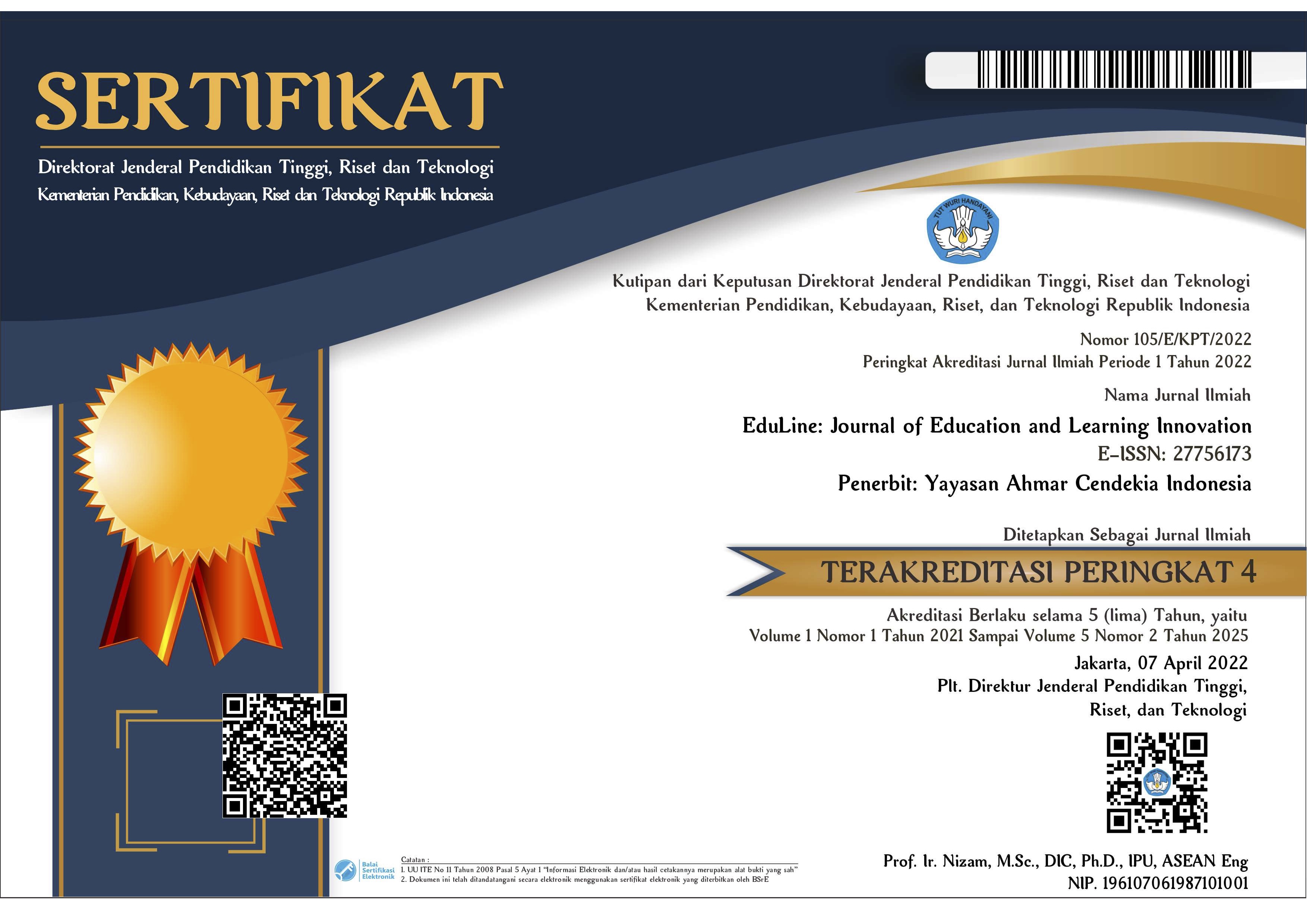
Scout Extracurricular Participation and Student Learning Motivation in Islamic Senior High Schools
- Publication History
- Published online: September 30, 2026
- DOI
- https://doi.org/10.35877/454RI.eduline5204
- Copyright
- Copyright (c) 2026 Dewi Yuniska, Sandi, Sahiruddin
- User License
- https://creativecommons.org/licenses/by-nc-sa/4.0
Abstract
Extracurricular activities provide students with opportunities to develop discipline, leadership, character, and active learning habits beyond formal classroom instruction. Scout extracurricular activities are particularly relevant because they combine experiential learning, teamwork, responsibility, and character formation that may be associated with students’ motivation to learn. This study examines the relationship between participation in Scout extracurricular activities and student learning motivation in an Islamic senior high school context. A quantitative ex post facto design was employed involving 48 students who actively participated in Scout activities, with all members of the population included through saturated sampling. Data were collected using a structured questionnaire and analyzed through descriptive statistics, validity and reliability testing, normality and linearity testing, and simple linear regression analysis. The findings indicate a positive and statistically significant relationship between Scout extracurricular participation and student learning motivation, with a significance value below 0.001. The regression model produced the equation Y = 30.049 + 0.488X, while the coefficient of determination of 0.364 indicates that Scout extracurricular participation accounted for 36.4% of the variance in student learning motivation. These findings suggest that structured extracurricular participation is associated with stronger learning motivation and may support schools in fostering discipline, responsibility, engagement, and positive learning attitudes through experiential activities.
Keywords
References (10)
- Afresda, S., Toharudin, M., & Sunarsih, D. (2023). Penanaman Pendidikan Karakter Profil Pelajar Pancasila Melalui Kegiatan Ekstrakurikuler Pramuka. 06(01), 8021–8040.
- Agrifina, V. F. (2024). Pedagogika?: Jurnal Pedagogik dan Dinamika Pendidikan. 12(2), 414–431.
- Anhusadar, L. O. (2021). Efektivitas Pembelajaran Online Pendidik PAUD di Tengah Pandemi Covid 19. 5(1), 686–697. https://doi.org/10.31004/obsesi.v5i1.699
- Arsini, Y. (2023). Jurnal mudabbir. 3, 27–35.
- Ningrum, R. W., Ismaya, E. A., Fajrie, N., & Artikel, S. (2020). Faktor – Faktor Pembentuk Karakter Disiplin dan Tanggung Jawab Dalam Ekstrakurikuler Pramuka. 3(1).
- Rumiati, S. (2025). Pengembangan Program Ekstrakurikuler Pramuka Berbasis Blok Dalam Meningkatkan Karakter Tanggung Jawab dan Motivasi Belajar Siswa. 5(2), 143–154.
- Sahiruddin, S. (2025). Penerapan Model Pembelajaran Meningkatkan Hasil Belajar Siswa Rotation Trio exchange Untuk. 3(4), 2120–2126.
- Sandi, A. H. (2024). Pengatuh Model Pembelajaran Problem Based Instruction dalam Meningkatkan Kemandirian Belajar Siswa Kelas XI UPT SMA 16 Bone. 105–114.
- Syafiudin, M. (2021). A U LADA: Jurnal Pendidikan dan Perkembangan Anak e-ISSN:2656-1638, Volume III, (1),2021 Muhamad Syafiudin. III(1), 71–82.
- Yusdinar, P., Manik, Y. M., Terbuka, U., & Malang, K. (2023). Pengaruh Ekstrakurikuler Pramuka terhadap Pembentukan Karakter Siswa. April, 183–190. https://doi.org/10.47709/educendikia.v3i01.2407
How to Cite
Copyright & license

This work is licensed under a Creative Commons Attribution-NonCommercial-ShareAlike 4.0 International License.