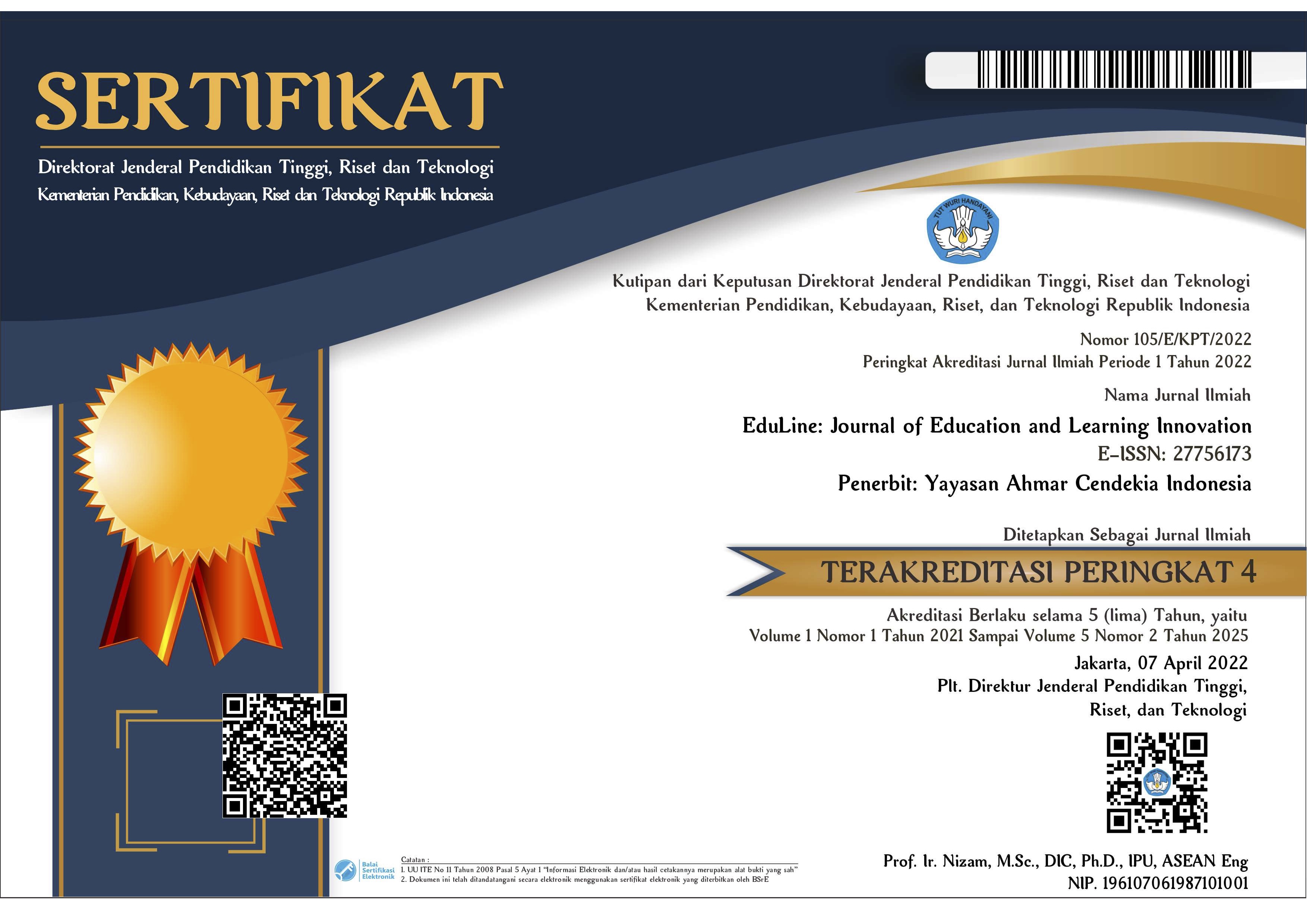
Teachers' Candidates’ Perceptions and Their Knowledge of 21st-Century Skills
- Dewi Satria Ahmar — Department of Chemistry Education, Universitas Tadulako, Indonesia, Indonesia
- Muhammad Fath Azzajjad — Universitas Sembilanbelas November Kolaka, Indonesia
- Lilies Tangge — Universitas Tadulako, Indonesia
- Mohammad Jamhari — Universitas Tadulako, Indonesia
- Ratman — Universitas Tadulako, Indonesia
- Afadil — Universitas Tadulako, Indonesia
- Publication History
- Published online: March 31, 2023
- DOI
- https://doi.org/10.35877/454RI.eduline1698
- Copyright
- Copyright (c) 2023 Dewi Satria Ahmar, Muhammad Fath Azzajjad, Lilies Tangge, Mohammad Jamhari, Ratman, Afadil
Abstract
The purpose of this study was to analyze the perceptions of teachers' candidates’ facing 21st-century skills. This research is a survey research, survey research activities carried out on students of Universitas Sembilanbelas November Kolaka from the Chemistry Education S-1 in 3 different batches. Data collection and collection were carried out from January to June 2021. The instrument is in the form of student perceptions in the form of 12 statements and 10 questions. The number of respondents who filled out the questionnaire was 40 people. The data analysis process was carried out by measuring the percentage of each statement and question. obtained information on 4C (communication, collaboration, critical thinking, and creativity) still obtained weaknesses in the level of understanding of the Knowledge of creative and innovative thinking, namely 15 respondents (37.5%) and the concept of understanding the knowledge of the teacher's social competence, namely 14 respondents (35%). The results of the study are taken into consideration for the learning process in courses related to the knowledge base of becoming a teacher, which is important to be carried out contextually in the process of direct practice in a formal environment in a measurable and sustainable manner.
Keywords
References
- Ahmar, D. S., Azzajjad, M. F., & Syahrir, Muh. (2020). Students’ Representation Ability In Chemistry. Journal Of Applied Science, Engineering, Technology, And Education, 2(2), 181–187. Https://Doi.Org/10.35877/454ri.Asci22124
Andriani, P. T., Sudatha, I. G. W., & Suartama, I. K. (2021). E-Summary Teaching Materials With Hannafin & Peck Models For Training Participants In The Human Resources Development Agency. Indonesian Journal Of Educational Research And Review, 4(3), 534. Https://Doi.Org/10.23887/Ijerr.V4i3.40131
Asmaroini, A. P. (2016). Implementasi Nilai-Nilai Pancasila Bagi Siswa Di Era Globalisasi. 4(2).
Banihashem, S. K., Farrokhnia, M., Badali, M., & Noroozi, O. (2022). The Impacts Of Constructivist Learning Design And Learning Analytics On Students’ Engagement And Self-Regulation. Innovations In Education And Teaching International, 59(4), 442–452. Https://Doi.Org/10.1080/14703297.2021.1890634
Dewantara, J. A., Hermawan, Y., Yunus, D., Prasetiyo, W. H., Efriani, E., Arifiyanti, F., & Nurgiansah, T. H. (2021). Anti-Corruption Education As An Effort To Form Students With Character Humanist And Law-Compliant. Jurnal Civics: Media Kajian Kewarganegaraan, 18(1), 70–81. Https://Doi.Org/10.21831/Jc.V18i1.38432
Djollong, A. F. (2017). Kedudukan Guru Sebagai Pendidik.
Faiz, A., & Kurniawaty, I. (2022). Urgensi Pendidikan Nilai Di Era Globalisasi. Jurnal Basicedu, 6(3), 3222–3229. Https://Doi.Org/10.31004/Basicedu.V6i3.2581
Gilroy, M. (2022). Reading The Global City: Crisis, Cognitive Mapping And The “Urban Sensorium” In Tom Mccarthy’s Satin Island And Ben Lerner’s 10:04. Clcweb: Comparative Literature And Culture, 24(1). Https://Doi.Org/10.7771/1481-4374.4285
Hamid, A. (2017). Guru Profesional. Al-Falah: Jurnal Ilmiah Keislaman Dan Kemasyarakatan, 17(2), 274–285. Https://Doi.Org/10.47732/Alfalahjikk.V17i2.26
Hazmi, N. (2019). Tugas Guru Dalam Proses Pembelajaran. Journal Of Education And Instruction (Joeai), 2(1), 56–65. Https://Doi.Org/10.31539/Joeai.V2i1.734
Innab, A., Albloushi, M., Alruwaili, M., Alqahtani, N., Alenazi, L., & Alkathiri, A. (2022). The Influence Of Sense Of Community And Satisfaction With E-Learning And Their Impact On Nursing Students’ Academic Achievement. The International Review Of Research In Open And Distributed Learning, 23(4), 19–34. Https://Doi.Org/10.19173/Irrodl.V23i4.6436
Karata?, K., & Kaya, ?. (2015). An Investigation Of The Perceptions Of School Administrators Towards The Roles And Duties Of School Counselors. Eurasian Journal Of Educational Research, 15(61), 181–198. Https://Doi.Org/10.14689/Ejer.2015.61.10
M. Ag, H. A. (2014). A Study For Searching New Foundation Of Philosophy Of Islamic Education To Revitalizing The Teacher Roles And Duties In Globalization Era. International Journal Of Social Science And Humanity, 4(5), 391–396. Https://Doi.Org/10.7763/Ijssh.2014.V4.385
Oktariani, O., Febliza, A., & Fauziah, N. (2020). Keterampilan Berpikir Kritis Calon Guru Kimia Sebagai Kesiapan Menghadapi Revolusi Industri 4.0. Journal Of Natural Science And Integration, 3(2), 114. Https://Doi.Org/10.24014/Jnsi.V3i2.8791
Reddy, K. (2018). The Duties And Responsibilities Of A Medical Teacher. Journal Of Gandaki Medical College-Nepal, 11(1), 52–55. Https://Doi.Org/10.3126/Jgmcn.V11i1.20795
Tabroni, I., Nasihah, F., & Bahijah, I. (2021). The Implementation Of School Culture-Based Character Education In Salem State Elementary School, Pondoksalam Subdistrict, Indonesia. Erudio: Journal Of Educational Innovation, 8(2), 202–208. Https://Doi.Org/10.18551/Erudio.8-2.9
Treska, L., & Treska, T. (2016). The Role, Responsibilities And Duties Of The Homeroom Teacher In Albania Education System During The Communist Regime (1945 – End Of ’60-S). European Journal Of Social Sciences Education And Research, 8(1), 49. Https://Doi.Org/10.26417/Ejser.V8i1.P49-57
Yusuf, A., Syahputra, R., & Lubis, J. (2022). Applied Of Statistics To Building Entrepreneurship Intention Through Self Efficacy, Adversity Quotient, And Need For Achievement In Students Of The Faculty Of Economics And Business, Labuhanbatu University. Jinav: Journal Of Information And Visualization, 3(2), 149–155. Https://Doi.Org/10.35877/454ri.Jinav1456