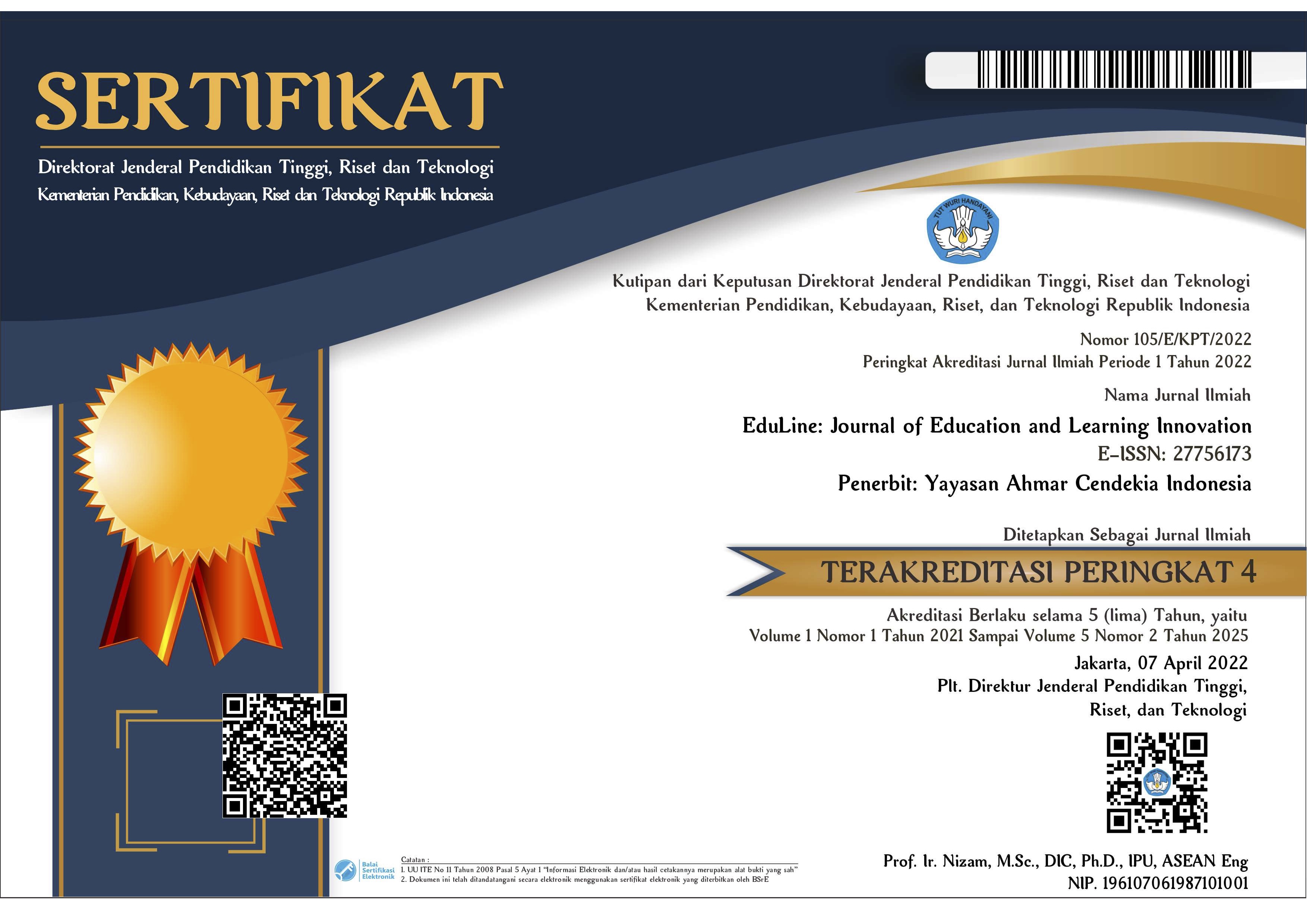
Prospective Teachers’ Barriers in Field Practice Experience
- Dessy Kurniasy — English Department of Tarbiyah and Teacher Training Faculty, State Institute of Islamic Studies (IAIN) Langsa, Kota Langsa, Aceh, Indonesia, Indonesia
- Zahratul Idami — English Department of Tarbiyah and Teacher Training Faculty, State Institute of Islamic Studies (IAIN) Langsa, Kota Langsa, Aceh, Indonesia, Indonesia
- Shafrida Wati — English Department of Tarbiyah and Teacher Training Faculty, State Institute of Islamic Studies (IAIN) Langsa, Kota Langsa, Aceh, Indonesia, Indonesia
- Sekar Ayu Lestari — English Department of Tarbiyah and Teacher Training Faculty, State Institute of Islamic Studies (IAIN) Langsa, Kota Langsa, Aceh, Indonesia, Indonesia
- Publication History
- Published online: June 30, 2023
- DOI
- https://doi.org/10.35877/454RI.eduline1804
- Copyright
- Copyright (c) 2023 Dessy Kurniasy, Zahratul Idami, Shafrida Wati, Sekar Ayu Lestari
Abstract
Teaching Practice Experience Program is one of the mandatory courses for all students of the faculty of education. This activity aims to provide real experience for students as prospective teachers. This study described prospective teachers' difficulties in practical teaching during their field practice experience program in Langsa, Aceh, Indonesia. This study applied a qualitative descriptive approach with a case study type of research. The participants were selected purposively. They were the seventh-semester students of the English Department who had conducted field practice experience consisting of 6 students. The data was collected through semi-structured interviews. The result revealed that among the barriers they encountered during their field practice experience were difficulties in facilitating a vibrant classroom atmosphere, teaching by using English, selecting and implementing appropriate methods or techniques, especially in teaching writing skills and challenges to execute lesson plans. Henceforth, this research contributes to enrich the literatures of field teaching practice and the barriers found, so it can be a valuable reference in the next research to provide the solution of the problems.
Keywords
References (11)
- Akinde, O. A., Harr, D., & Burger, P. (2017). Field Experience: Experiential Learning as Complementary to the Conceptual Learning for International Students in a Graduate Teacher Education Program. International Journal of Higher Education, 6(4), 137–151. https://doi.org/10.5430/ijhe.v6n4p13
- Anni, C, T., & Rifai, A. (2012). Educational Psychology. UPT Unnes Press.
- Arifin, M., & Barnawi, B. (2015). Microteaching; Effective and Creative Teaching Theory and Practice. Yogyakarta: Ar-Ruzz Media.
- Aryani, Y. (2023). The influence of Practice Field Experience (PPL) and Interest in Becoming a teacher-on-Teacher Readiness in Students of Muhammadiyah University Prof. Dr. Hamka. Jurnal Pendidikan Ekonomi, Perkantoran, dan Akuntansi, 4(1), 301–314.
- Daryanto, D. (2013). Competency Standards and Professional Teacher Job Assessment. Yogyakarta: Penerbit Gava Media.
- Heafner, T., McIntyre, E., & Spooner, M. (2014). The CAEP standards and research on educator preparation programs: linking clinical partnerships with program impact. Peabody J. Educ, (89), 516–532. https://doi.org/10.1080/0161956X.2014.938998
- Hos, R., Cinarbas, H. I., & Yagci, H. (2019). A Head-Start to Teaching: Exploring the Early Field Experiences in Pre-service EFL Education in Turkey. International Journal of Teacher Education and Professional Development, 2(2), 68–84.
- https://doi.org/10.4018/IJTEPD.2019070105
- Sandelowski, M. (2000). What ever happened to qualitative description? Res Nurs Health.
- Sanjaya, W. (2013). Educational Process Standard Oriented Learning Strategy. Kencana Prenada Media Group.
- Suparman, A. (2012). Modern Instructional Design: A Guide for Educators and Educational Innovators. Jakarta: Penerbit Erlangga.