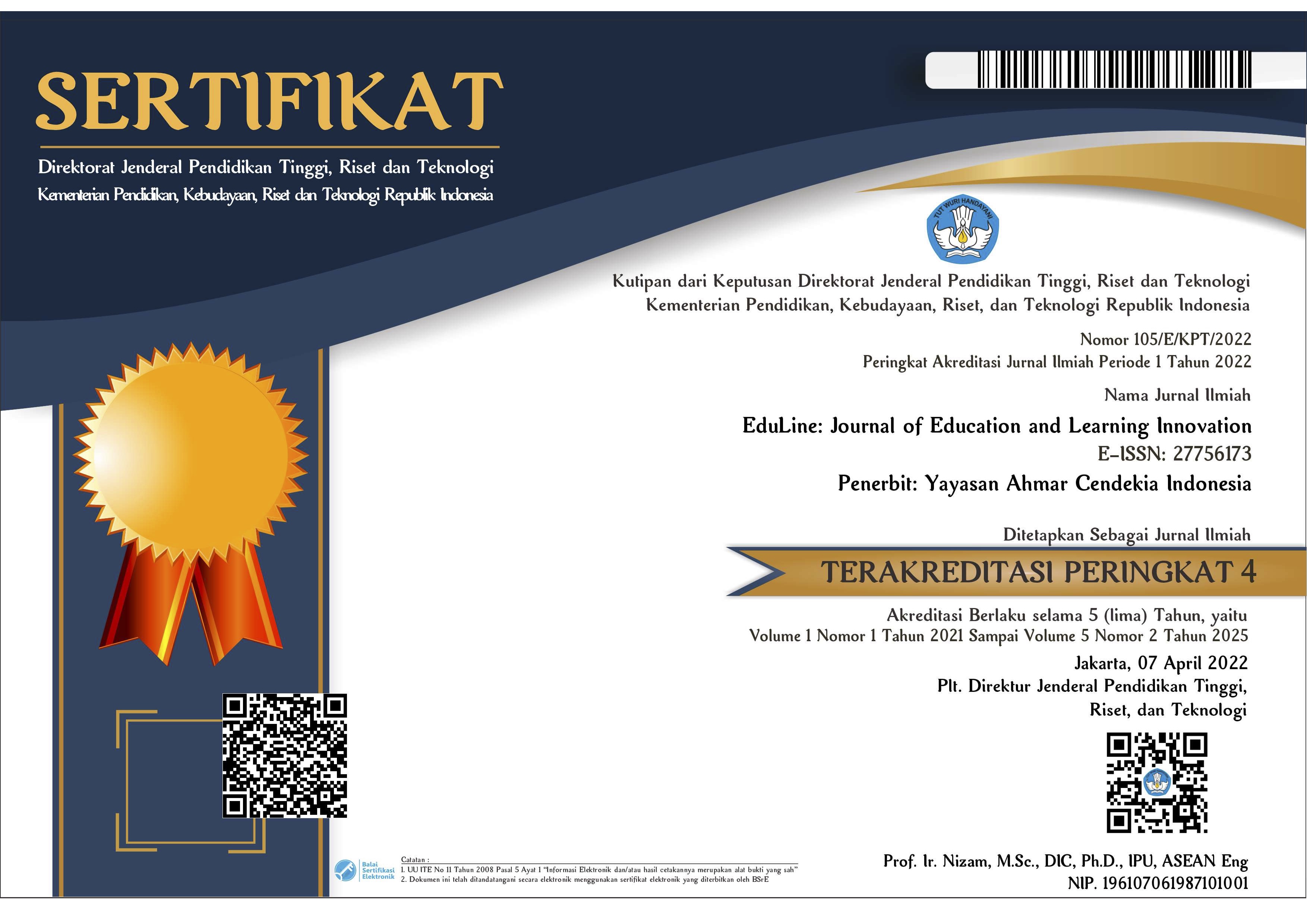
The Need for Active Learning is a Concern for Students’ Performance in ELT Context: A Case in Libya Educational School in North Cyprus
- Publication History
- Published online: December 26, 2024
- DOI
- https://doi.org/10.35877/454RI.eduline3156
- Copyright
- Copyright (c) 2024 Ben Bardis, Suhir Mohamed Khmis, Suhir Mohamed Krid
Abstract
The need to enhance language competence of students has become a contemporary issue to tackle in the domain of English Language Teaching (ELT). The fact remains persuasive as teaching and learning approaches must be significant and student-centred in order to enhance students’ language competence in teaching industries. Active learning involves evidence- based teaching tasks to make students take part massively and directly in classroom activities. The purpose of the study is to explore the perception of both the teaching staff and the school managers on the dynamics of active learning. The participants of the study are 10 teachers (6 Females and 4 Males) and 3 Managers in Secondary School Section of Libyan Educational School in North Cyprus. The investigation entails a qualitative method by using interview guide questions for both the EFL teaching staff and school managers. The study’s findings indicate that, though the teachers and their managers are aware of active learning, they however lack logistics to implement and sustain its policies. The pedagogical implication stresses on the following strategical issues such as Fundamental strategy; Emphasis on positive learning styles; Reassurance for student-student’s interactive communication and Making students innovators and self-sufficient in learning. Furthermore, these strategic tasks serve as a take-home knowledge to engross our students in active learning for the enhancement of the four language skills in English as a foreign language (EFL) context.
Keywords
References
- Bakoush, O., and Benamer Hts(2008):. "Could lectures be stimulating? An approach to encourage active learning." Libyan Journal of Medicine 3.2 62-62
Bano, H., Ashraf, S., and Zia, S. (2013) Conflict: factors and resolution strategies adopted by administrators of schools for visually impaired students. Mediterranean Journal of Social Sciences, 4(4), 405-408
Borg, S (Ed) (2015c) Professional development for English language teachers: Perspectives from higher education in Turkey, London: British Council.
Bransford, J.D., Brown, A.L., and Cocking, R.R. (Eds.) (1999). How people learn: Brain, mind, experience, and school. Washington, D.C.: National Academy Press.
Chomsky, N. (1960-1965). Aspects of the theory of syntax. Boston, MA: The MIT Press.
Chomsky, N.(1980).Rules and Representations. New York: Columbia University Press
Creswell J.W. (2013. )Research Design Qualitative, Quantitative, and Mixed Methods ApproachesSAGE Publications, Inc
Creswell, J.W. (2012). Educational research: Planning, conducting, and evaluating quantitative and Qualitative research(4thed.).Upper Saddle River, NJ: Merrill.
Debbek, Sarah( 2015) Instructors' and students' perceptions of active learning in Libyan higher education institutions. Diss. Washington State University,
Deslauriers, L., McCarty, L. S., Miller, K., Callaghan, K., & Kestin, G. (2019). Measuring actual learning versus feeling of learning in response to being actively engaged in the classroom. Proceedings of the National Academy of Sciences, 116(39), 19251–19257.
Doman, E., Webb, M., & Pusey, K. (2014). Flipping a Chinese university EFL course: What
students and teachers think of the model. The Journal of Asia TEFL 11(4), 53-84. Retrieved
from http://goo.gl/ZmK2lF
Dunn, Joe P. (2019): "A “model” for active learning and leadership development: International model NATO." Journal of Political Science Education 15.4 528-534
Egeberg, H. M., McConney, A., & Price, A. (2016). Classroom Management and National Professional Standards for Teachers: A Review of the Literature on Theory and Practice. Australian Journal of Teacher Education, 41(7).
Elliott, S.N., Kratochwill, T.R., Littlefield Cook, J. & Travers, J. (2000). Educational psychology: Effective teaching, effective learning (3rd ed.) . Boston, MA: McGraw-Hill College.
Freeman, S., Eddy, S. L., McDonough, M., Smith, M. K., Okoroafor, N., Jordt, H., & Wenderoth, M. P. (2014). Active learning increases student performance in science, engineering, and mathematics. Proceedings of the National Academy of Sciences, 111(23), 8
Galaczi, E (2015) Cambridge English Professional development in Portugal: Programme impact, Cambridge Assessment English internal report.
Harmer, J. (2001). The practice of English language teaching. Longman.
Harms, E. & Myers, C. (2013). Empowering students through speaking round tables. Language Education in Asia 4(1), 39-59http://dx.doi.org/10.5746/LEiA/13/V4/I1/A4/Harms_Myers
Ito, H. (2016). Rethinking active learning in the context of Japanese higher education. http://www.tandfonline.com/doi/full/10.1080/2331186X.2017.1298187 Japan Association for
Kerry Pusey(2016): Practical Strategies for Promoting Active Learning in the EFL Classroom TESOL Spain 39th Annual National Convention, March 11-13, Nagasaki University ! kpusey@nagasaki-u.ac.jp
Kipruto. I, and Kipkemboi. F.(2013). Assessment of factors influencing management
conflicts in church sponsored public secondary schools in Kenya: International Journal of Scientific & Technology Research, 2(6), 241-246
Makaye, J., and Ndofirepi, A.P. (2012). Conflict resolution between heads and teachers: the
case of 4 schools in Masvingo Zimbabwe. Greener Journal of Educational Research, 2(4), 105 – 110.
Mapolisa and, T. ,and Tshabalala. T.. 2013. An investigation into the causes of conflict in
Zimbabwean schools: A case study of Nkayi south circuit. Journal of Humanities and Social
Sciences, 1(1): 13-22
Outsell (2016) K-12 Teacher Professional Development: Market Size, Forecast, and Trends, London: Outsell.
Ramani K and Zhimin, L. (2010). A survey on conflict resolution mechanisms in public
secondary schools: A case of Nairobi province, Kenya. Educational Research and Reviews
Vol. 5 (5), 242-256.
Skinner,B.F.(1957). Verbal behavior .Englewood Cliffs,N J : Prentice-Hall.
Smith, K.A., Sheppard, S.D., Johnson, D.W., and Johnson, R.T. (2013). Pedagogies of Engagement: Classroom-Based Practices. Journal of Engineering Education, v 94, 87410–8415.
Sunal, D. W. (2015), Sunal, D.W. (n.d.). The learning cycle: A comparison of models of strategies for conceptual reconstruction: A review of the literature. Retrieved from http: //astlc.ua.edu/ Science In Elem & Middle School/565LearningCycle-ComparingModels.htm.
Sunal, D.W. (2021) The Learning Cycle: A Comparison of Models of Strategies for Conceptual Reconstruction: A Review of the Literature. Available online: (accessed on 10 September 2021).
Sri Sri Rachmajanti, Gunadi Harry Sulistyo, , Fika Megawati, Ayu Alif Nur Maharani Akba(2020): Professional development as viewed by EFL teachers at lower secondary school, 1English Department, Universitas Negeri Malang, Indonesia, 2English Langauge Education
Theobald, E. J., Hill, M. J., Tran, E., Agrawal, S., Arroyo, E. N., Behling, S., Chambwe, N., Cintrón, D. L., Cooper, J. D., Dunster, G., Grummer, J. A., Hennessey, K., Hsiao, J., Iranon, N., Jones, L., Jordt, H., Keller, M., Lacey, M. E., Littlefield, C. E., … Freeman, S. (2020). Active learning narrows achievement gaps for underrepresented students in undergraduate science, technology, engineering, and math. Proceedings of the National Academy of Sciences, 117(12), 6476–6483.
Thomas, M. (2017). Project-based language learning with technology. Routledge.
.
Thorndike, E. (1921-1932),Theory of Behaviour: The Fundamentals of Learning, AMS Press Inc. ISBN978-0-404-06429-7.
Watson,J.B.( 1925- 1930). Behaviorism (rev.ed), NewYork: Norton