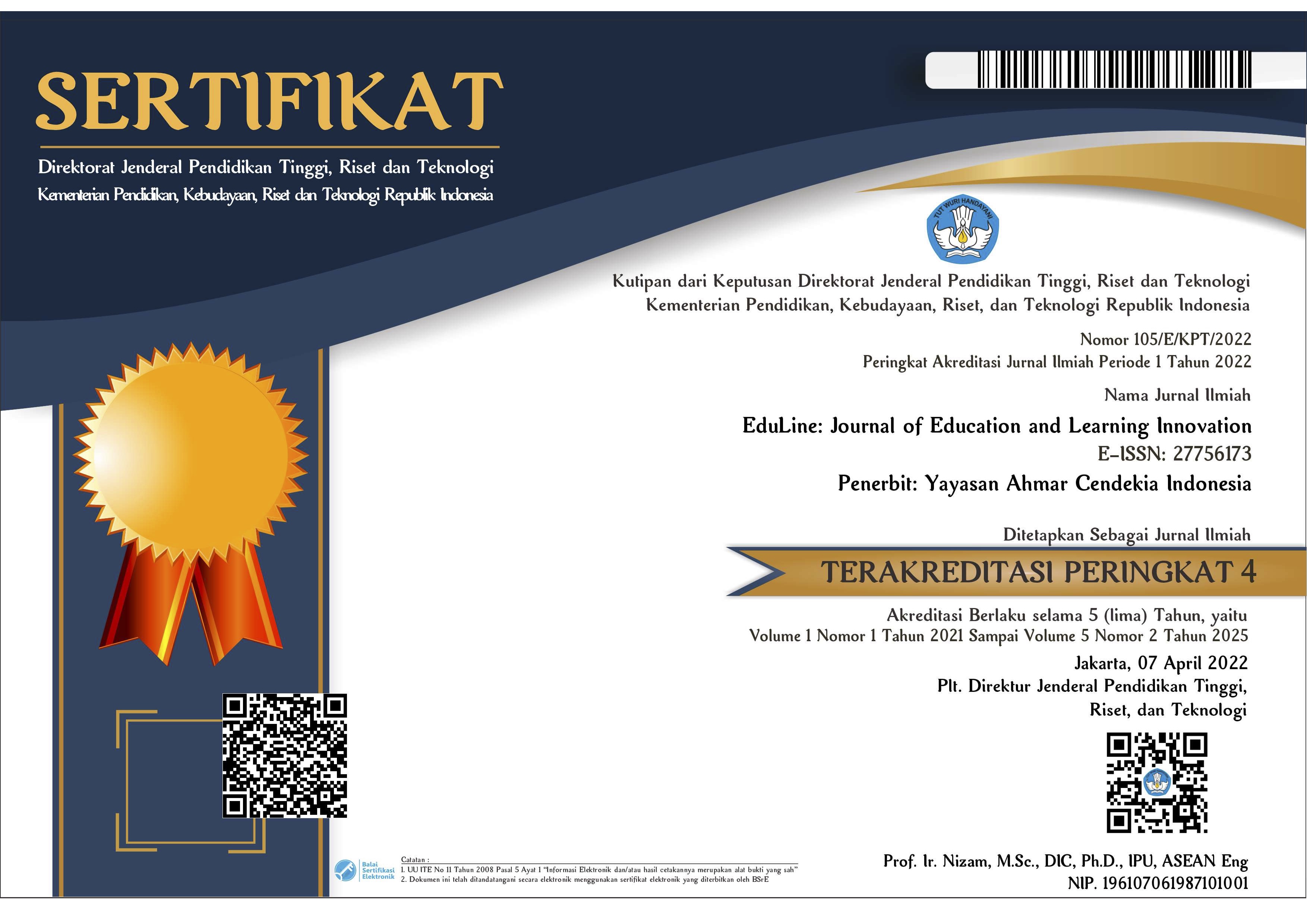
Learning by Utilizing Virtual Classes (Facebook) in Increasing Learning Motivation to Deal with Distance Learning for High School Students
- Dewi Maya Sari — Labuhanbatu University, Jalan Sisingamangaraja No.126 A KM 3.5, 21418, Indonesia, Indonesia
- Julia Satifa — Labuhanbatu University, Jalan Sisingamangaraja No.126 A KM 3.5, 21418, Indonesia, Indonesia
- Latifah Adiba — Labuhanbatu University, Jalan Sisingamangaraja No.126 A KM 3.5, 21418, Indonesia, Indonesia
- Neliwati — Labuhanbatu University, Jalan Sisingamangaraja No.126 A KM 3.5, 21418, Indonesia, Indonesia
- Publication History
- Published online: December 18, 2022
- DOI
- https://doi.org/10.35877/454RI.eduline1351
- Copyright
- Copyright (c) 2022 Dewi Maya Sari, Julia Satifa, Latifah Adiba, Neliwati
Abstract
Distance education is playing an important role during this pandemic, and its systems are helping learning service providers manage, plan, deliver, and track teaching and learning. Due to its ubiquity (anywhere and anytime), low cost, ease of use and interactivity, much like a digital video conferencing platform. Distance learning is an opportunity to increase the efficiency of the teaching and learning process. School organizers are encouraged to be able to adapt to conditions where the development of distance learning is no longer a new phenomenon at this time. This study wants to examine the factors that drive high school students' motivation in conducting distance learning. This research was conducted in the city of Medan, North Sumatra. the sample in this study were 100 students who had done distance learning. the independent variables in this study are engagement, community building and personal learning environment. The results showed that all predictor variables in this study had a positive and significant effect on students' motivation in conducting distance learning. It is hoped that this research can contribute to the case of distance learning in high school students.
Keywords
References (26)
- Anjomshoa, Leila; Sadighi, F. (2015). The Importance of Motivation in Second Language Acquisition. Arc Journal, 3(2).
- Astinx, A. (1984). Student involvement: A developmental theory for higher education. Journal of College Student Personnel, 25(4), 297–308.
- Attwell, G. (2006). Personal Learning Environments-the future of eLearning? ELearning Papers, 2.
- Bingham, T., & Conner, M. (2010). The New Social Learning: A Guide to Transforming Organizations Through Social Media. Berrett-Koehler Publishers.
- Britt, T. W., Adler, A. B., & Bartone, P. T. (2001). Deriving benefits from stressful events: The role of engagement in meaningful work and hardiness. In Journal of Occupational Health Psychology (Vol. 6, pp. 53–63). Educational Publishing Foundation. https://doi.org/10.1037/1076-8998.6.1.53
- Dixon, F. A., & Moon, S. M. (2021). The Handbook of Secondary Gifted Education. Taylor & Francis.
- Downes, S. (1999). Creating an online learning community. University of Alberta. University of Alberta.
- Experian Marketing Services. (n.d.). The 2012 Digital Marketer: Benchmark and Trend Report. http://www.experian.com/marketingservices/register-2011-digital-marketer.html
- Fasching-Varner, K. J., Bickmore, S. T., & Schrader, P. G. G. (2020). The Corona Chronicles: On Leadership, Processes, Commitments, and Hope in Uncertain Times. DIO Press Incorporated.
- Harmaelen, M. . (2020). Design trajectories: four experiments in PLE implementation. In Interactive Learning Environments. 16(1).
- Heiberger, G., & Harper, R. (2008). Have You Facebooked Astin Lately? Using Technology to Increase Student Involvement. New Directions for Student Services, 2008, 19–35. https://doi.org/10.1002/ss.293
- Hrastinski, S., & Aghaee, N. (2012). How are campus students using social media to support their studies? An explorative interview study. Education and Information Technologies, 17. https://doi.org/10.1007/s10639-011-9169-5
- Huang, Y., Backman, S. J., & Backman, K. F. (2018). An investigation of motivation and experience in virtual learning environments : a self-determination theory. Boellstorff 2015.
- Institute, H. E. R. (2007). College freshmen and online social networking sites. Higher Education, September, 1–3.
- Junco, R., Heiberger, G., & Loken, E. (2011). The Effect of Twitter on College Student Engagement and Grades. Journal of Computer Assisted Learning, 27, 119–132. https://doi.org/10.1111/j.1365-2729.2010.00387.x
- Kuh, G. D. (2009). The national survey of student engagement: Conceptual and empirical foundations. New Directions for Institutional Research, 2009(141), 5–20. https://doi.org/https://doi.org/10.1002/ir.283
- Lee, W., Xiong, L., & Hu, C. (2012). The effect of Facebook users’ arousal and valence on intention to go to the festival: Applying an extension of the technology acceptance model. International Journal of Hospitality Management - INT J HOSP MANAG, 31. https://doi.org/10.1016/j.ijhm.2011.09.018
- Litmos. (2019). E-Learning Platform Definitions. https://www.researchgate.net/deref/https%3A%2F%2Fwww.litmos.com%2Fplatform%2Fe-learning-platform-definition
- Maslow, A. H. (1970). Motivation and Personality. Harper & Row.
- Merriam-Webster, I. (1994). Merriam-Webster’s Dictionary of English Usage. Merriam-Webster, Incorporated. https://books.google.co.id/books?id=2yJusP0vrdgC
- Nyakundi, G. M. (2020). Influence of Competence on Performance of Teachers in Public Secondary Schools in Kisii County-Kenya. Journal of Education and Practice, 11(3), 173–180. https://doi.org/10.7176/jep/11-3-19
- Pascarella, E., & Terenzini, P. (2005). How college affects students: A third decade of research. 2.
- Ryan, R. M., & Deci, E. L. (2000). Self-determination theory and the facilitation of intrinsic motivation, social development, and well-being. In American Psychologist (Vol. 55, pp. 68–78). American Psychological Association. https://doi.org/10.1037/0003-066X.55.1.68
- sugiyono. (2017). Metode penelitian kuantitatif . In 2017 .
- Sugiyono, D. (2013). Metode Penelitian Kuantitatif, Kualitatif, dan Tindakan.
- van Harmelen, M. (2008). Design trajectories: four experiments in PLE implementation. Interactive Learning Environments, 16(1), 35–46. https://doi.org/10.1080/10494820701772686