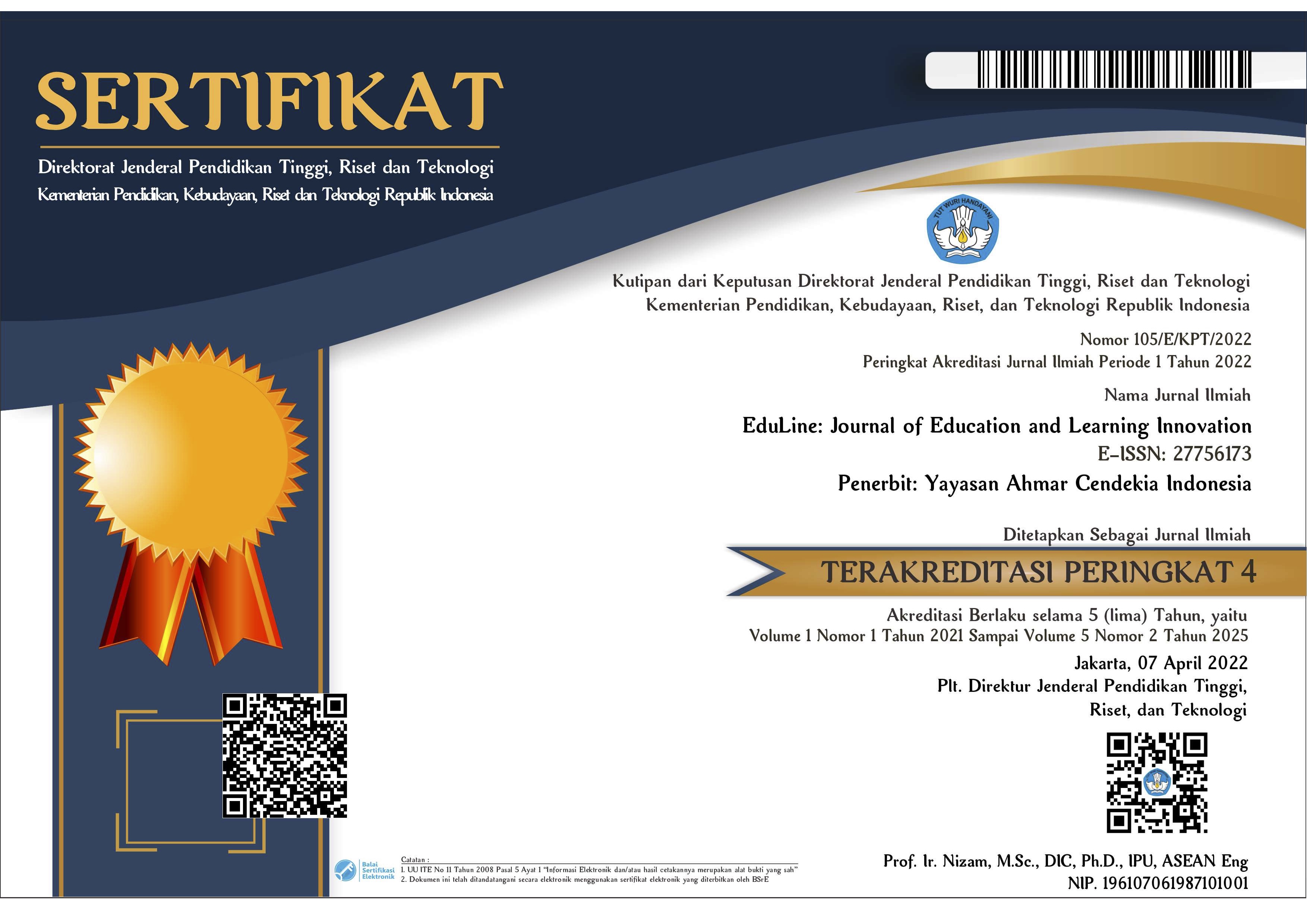
Experiences of Instructors in Online Teaching: A Phenomenological Study
- Publication History
- Published online: August 29, 2021
- DOI
- https://doi.org/10.35877/454RI.eduline542
- Copyright
- Copyright (c) 2021 Genelyn Baluyos, Ariel R. Clarin Baluyos
Abstract
The abrupt shift to online distance education as a result of COVID-19 pademic resulted to the diversification of teaching modalities and pedagogies. This study explored the lived experiences of instructors in online teaching during the SY 2020-2021 using Van Manen's hermeneutic phenomenological design. Purposive sampling was used to select the twenty-five participants for the study. In-depth face-to-face interviews were conducted with all the participants to gather information from the teachers. Data analysis was employed using the six components of hermeneutic phenomenological design and with the aid of NVivo software. Results revealed that the instructors’ experiences in online teaching were identified in five themes: preparation of learning materials, realization of learning outcomes, stability of internet connection, availability of technological resources, and difficulty in the conduct of assessment activities. The instructors encountered positive and negative experiences in online teaching. Online teaching enhancement program is recommended in this study.
Keywords
References
- Adebisi, T. A., & Oyeleke, O. (2018). PROMOTING EFFECTIVE TEACHING AND LEARNING IN ONLINE ENVIRONMENT: A BLEND OF PEDAGOGICAL AND ANDRAGOGICAL MODELS. Bulgarian Journal of Science and Education Policy, 12(1), 153-172. Retrieved from https://www.proquest.com/docview/2121528954?accountid=149218
Allen, I. E., Seaman, J., Lederman, D., & Jaschik, S. (2012). Conflicted: Faculty and online education. Washington: Inside Higher Ed., Babson Survey Research Group, and Quahog Research Group. https://eric.ed.gov/?id=ED535214
Badia, A., Garcia, C., & Meneses, J. (2019). Emotions in response to teaching online: Exploring the factors influencing teachers in a fully online university: Journal of the association for programmed learning. Innovations in Education and Teaching International, 56(4), 446-457. doi:http://dx.doi.org/10.1080/14703297.2018.1546608
Bolliger, D. U., Inan, F. A., & Wasilik, O. (2014). Development and validation of the online instructor satisfaction measure (OISM). Journal of Educational Technology & Society, 17(2), 183-195. Retrieved on October 31, 2020 from https://www.jstor.org/stable/pdf/jeductechsoci.17.2.183.pdf
Cacayan, E. B., Baua, M. E. C., & Alvarado, A. E. (2020). Challenges in Nursing Education in the New Normal: Basis for Faculty Enhancement Program. Health Notions, 4(8), 234-247.
Chatterjee, R., Juvale, D., & Jaramillo, N. (2018). Experiences of Online Instructors through Debriefs: A Multi-Case Study. stannual, 37. https://members.aect.org/pdf/Proceedings/proceedings18/2018/18_06.pdf
Ching, Y. H., Hsu, Y. C., & Baldwin, S. (2018). Becoming an online teacher: An analysis of prospective online instructors’ reflections. Journal of Interactive Learning Research, 29(2), 145-168. Retrived on November 2, 2020 from https://www.learntechlib.org/p/181339/
Cho, M. H., & Cho, Y. (2016). Online instructors’ use of scaffolding strategies to promote interactions: A scale development study. International Review of Research in Open and Distributed Learning: IRRODL, 17(6), 108-120. https://www.erudit.org/en/journals/irrodl/1900-v1-n1-irrodl04869/1064642ar/abstract/
Cross, T., & Pollk, L. (2018). Burn Bright, Not Out: Tips for Managing Online Teaching. Journal of Educators Online, 15(3), n3. https://eric.ed.gov/?id=EJ1199109
Gillett-Swan, J. (2017). The challenges of online learning: Supporting and engaging the isolated learner. Journal of Learning Design, 10(1), 20-30. Retrieved on November 5, 2020 from https://eprints.qut.edu.au/102750/
Gurley, L. E. (2018). Educators' Preparation to Teach, Perceived Teaching Presence, and Perceived Teaching Presence Behaviors in Blended and Online Learning Environments. Online learning, 22(2), 197-220.Retrieved on November 10, 20202 from https://eric.ed.gov/?id=EJ1181399
Hulett, Marie Thérèse (2018).California State University, Fullerton, ProQuest Dissertations Publishing10809485.https://search.proquest.com/openview/725d805c4a841391f5e2f11d3bbc7364/1?pq-origsite=gscholar&cbl=18750&diss=y
Ifeanyi, B. O., & Chukwuone, C. A. (2018). Constraints to the use of online platform for teaching and learning technical education in developing countries. Education and Information Technologies, 23(6), 3029-3045. doi:http://dx.doi.org/10.1007/s10639-018-9757-8
Jeffrey, L. M., Milne, J., Suddaby, G., & Higgins, A. (2014). Blended learning: How teachers balance the blend of online and classroom components. Journal of Information Technology Education, 13.
Johns, Helen (2020). "Online Instructors’ Experiences and Adaptations to Transitions Within a Learning Management System" Walden Dissertations and Doctoral Studies. 9157.
https://scholarworks.waldenu.edu/dissertations/9157
Kumi Yeboah, A., Dogbey, J., Yuan, G., & Smith, P. (2020). Cultural Diversity in Online Education: An Exploration of Instructors’ Perceptions and Challenges. Teachers College Record, 122(7). https://scholarcommons.usf.edu/tal_facpub/517
Lightner-Laws, C. (2016). A blended model: Simultaneously teaching a quantitative course traditionally, online, and remotely. Interactive Learning Environments, 24(1), 224-238. doi:http://dx.doi.org/10.1080/10494820.2013.841262
Mansbach, J., & Austin, A. E. (2018). Nuanced perspectives about online teaching: Mid-career and senior faculty voices reflecting on academic work in the digital age. Innovative Higher Education, 43(4), 257-272. doi:http://dx.doi.org/10.1007/s10755-018-9424-4
Marasi, S., Jones, B., & Parker, J. M. (2020). Faculty satisfaction with online teaching: a comprehensive study with American faculty. Studies in Higher Education, 1-13.https://www.tandfonline.com/doi/full/10.1080/03075079.2020.1767050
Marasi, S., Jones, B., & Parker, J. M. (2020). Faculty satisfaction with online teaching: A comprehensive study with american faculty. Studies in Higher Education, Retrieved from https://www.proquest.com/docview/2405707038?accountid=149218
McGee, P., Windes, D., & Torres, M. (2017). Experienced online instructors: beliefs and preferred supports regarding online teaching. Journal of Computing in Higher Education, 29(2), 331-352.
McGhan, G., McCaughey, D., Landry, A., Allgood, A., & Menachemi, N. (2016). Health administration faculty members in online-only and traditional universities. The Journal of Health Administration Education, 33(2), 271-283. Retrieved from https://www.proquest.com/docview/1806107404?accountid=149218
Özcan, H., & Y?ld?r?m, S. (2018). Administrators' perceptions of motives to offer online academic degree programs in universities. International Review of Research in Open and Distributed Learning, 19(1) Retrieved from https://www.proquest.com/docview/2047921671?accountid=149218
Parker, B., & Hankins, J. (2002). The Joys and Sorrows of Teaching Computer Literacy Online. https://eric.ed.gov/?id=ED475945
Scoppio, G., & Luyt, I. (2017). Mind the gap: Enabling online faculty and instructional designers in mapping new models for quality online courses. Education and Information Technologies, 22(3), 725-746. doi:http://dx.doi.org/10.1007/s10639-015-9452-y
Stickney, L. T., Bento, R. F., Anil, A., & Veena, A. (2019). Online higher education: Faculty satisfaction and its antecedents. Journal of Management Education, 43(5), 509-542. doi:http://dx.doi.org/10.1177/1052562919845022
Van Manen, M. (2016). Phenomenology of practice: Meaning-giving methods in phenomenological research and writing. Routledge.
Wang, N., & Zhang, Y. (2019). Application status and promotion strategy of integrated network teaching platform-taking northwest A&F university as an example. Asian Agricultural Research, 11(4), 90-92. doi:http://dx.doi.org/10.19601/j.cnki.issn1943-9903.2019.4.021
Williams, N. V., & Casale, M. J. (2015). The Preparation of Teacher Candidates for K-12 Online Learning Environments: A Case Study. Mid-Western Educational Researcher, 27(2). Retrieved on November 10, 20202 from https://tinyurl.com/jepbavhs